
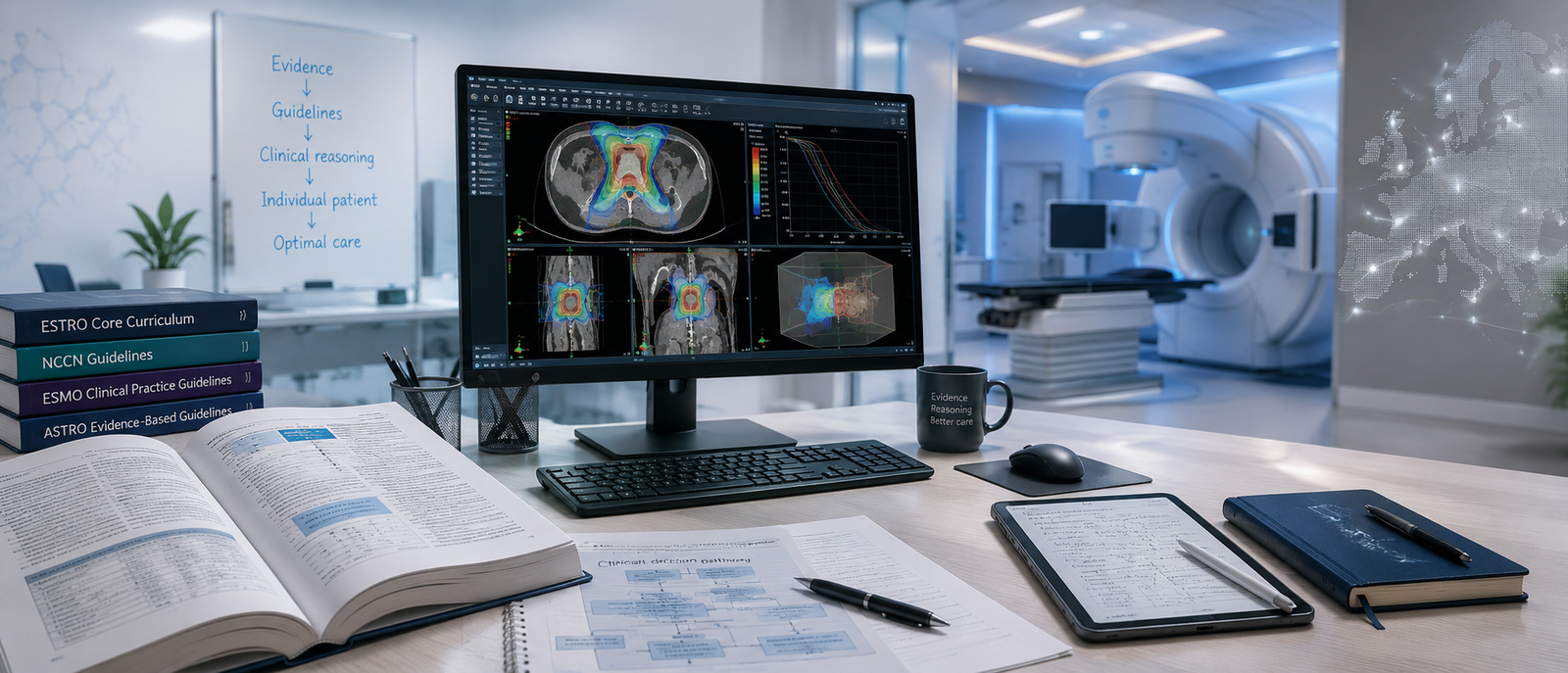
Clinical tools built on rules. Tested by humans. Decisions made by clinicians.
carcinologica.com is an experimental teaching and clinical-reasoning platform for oncology.
The core clinical pathways are hard-coded from documented sources.
They are not generated freely by AI.
Rules are written, sourced, versioned and tested. When the evidence changes, the rule can be reviewed and updated.
The clinician remains in control.
The platform can calculate.
It can stage.
It can organise information.
It can find missing or conflicting data.
It can show which options are supported by the encoded pathway.
But when medicine requires judgement, the system stops and asks the clinician.
These Human Decision Checkpoints are deliberate.
The aim is not to replace clinical reasoning.
The aim is to support it, challenge it and document it.
Why build this?
Radiation oncology knowledge is scattered across many places.
Anatomy lives in atlases.
Staging lives in TNM and FIGO.
Contouring lives in consensus guidelines and atlases.
Dose constraints live in protocols, guidelines and publications.
Systemic treatments and toxicities live in other resources.
Practical knowledge is also learned from courses, mentors and clinical experience.
A resident can learn all these pieces and still face the hardest question:
How do they connect for this patient?
carcinologica.com is not another oncology encyclopedia.
It is designed as a logical, progressive teaching environment.
One question leads to the next.
Only relevant information should appear.
Earlier answers shape later questions.
Missing information remains missing—not silently converted into a negative answer.
The objective is simple:
Make the reasoning easier to follow.
From evidence to a decision
The platform follows the clinical story.
Presentation → pathology → imaging → staging → treatment options → planning → toxicity → follow-up
At each step it can ask:
What do we know?
What is still missing?
Why does it matter?
What does the guideline say?
What could change the decision?
Where possible, the answer links directly to the relevant guideline, consensus document or other source.
The clinician should be able to check the evidence rather than simply trust the software.
Human Decision Checkpoints
Some answers can be calculated.
Others cannot.
A formula can calculate EQD2.
A defined staging rule can derive a stage from the required inputs.
But choosing treatment for an individual patient may depend on anatomy, previous treatment, comorbidities, toxicity, patient preference, feasibility and multidisciplinary judgement.
At those points, carcinologica.com deliberately returns control to the clinician.
Evidence → structured reasoning → options → HUMAN DECISION → documented rationale
If the clinician chooses differently from an encoded pathway, the objective is not to display “Wrong.”
The platform should instead ask:
Why?
It can show the relevant evidence, identify the difference and allow the reasoning to be documented.
A justified exception is part of medicine.
And an unexplained contradiction deserves another look.
Teaching while working
The same structure is designed to teach.
Residents should not have to memorise isolated facts and somehow assemble them years later.
They can see why one question follows another.
They can open:
Why? · Learn · Evidence · How was this derived?
Interactive cases can stop at important decisions and ask the learner what should happen next.
Wrong answers become teaching opportunities.
Difficult concepts can return later.
Anonymous learning patterns can help identify lessons that need improvement.
The objective is not simply to provide an answer.
It is to teach how the answer is built.
A project under active human testing
carcinologica.com is still under development.
Its clinical pathways require continued review, testing and correction by clinicians.
We actively want users to challenge them.
Found an error?
A missing exception?
A questionable source?
An unnecessary question?
A better way to teach something?
Tell us.
Clinical feedback is part of the development process.
The platform is not yet a validated substitute for clinical judgement, multidisciplinary discussion or established clinical systems, and it does not claim proven improvements in survival, toxicity, workload or healthcare costs.
Those questions require proper evaluation.
For now, the goal is more fundamental:
Build the rules carefully.
Show the evidence.
Keep uncertainty visible.
Challenge the reasoning.
Keep the human in control.
Learn from every test.
Development direction
Future development will focus on:
- maintaining current, traceable links to guidelines and primary evidence;
- expanding cancer-specific navigators and treatment-planning tools;
- supporting structured tumour-board preparation and documentation;
- comparing recommendations across countries and institutions;
- evaluating accuracy, clinician workload, decision consistency and patient-centred outcomes;
- preserving clinician oversight and transparent handling of uncertainty.
- developing progressive, case-based teaching with interactive reasoning, formative assessment and feedback-driven refinement of educational modules.
Plausible predictions