
Radiotherapy Engineering Lab
Educational Model Build Plans
Radiotherapy can be seen in action only indirectly. Specialized cameras can capture the exceedingly faint Cherenkov light produced within irradiated tissue and emerging from the patient’s skin. Phantoms, detectors and radiographic films can then tell us what the beam does at depth and around its target. Fascinating—but not exactly the easiest live demonstration.
Fortunately, beam shaping itself can be explored cheaply and safely in the visible spectrum. Visible light does not reproduce the interactions of megavoltage photons with tissue, nor does brightness represent absorbed dose. It does, however, allow us to see and control many of the geometrical principles on which radiotherapy depends: direction, divergence, collimation, field shape, alignment, convergence, geometric penumbra and mechanical precision.
The Scientific Committee at carcinologica.com—currently represented by its sole member, who also occupies every other position in this fine emerging project—therefore dares to suggest a safer way to explore how radiotherapy works: by replacing the invisible treatment beam with visible light, which is safe and fun to play with—even for your cat, although felines stubbornly refuse to file QA reports.
The projects range from simple, inexpensive tabletop demonstrators to considerably more ambitious engineering experiments. Together, they explore beam collimation and modulation, isocenter and treatment geometry, gantry and robotic motion, stepper-motor control, image guidance, camera feedback, coordinate registration, calibration, positioning, mechanical tolerances, repeatability, quality assurance, safety interlocks, error detection and treatment-delivery verification—the many systems that must cooperate before a modern radiotherapy machine is allowed to illuminate anything at all.
These are educational optical models, not medical devices. They do not reproduce radiation dose or tissue response. What they can do is make the machinery, logic and precision of modern radiotherapy visible, approachable, safe—and rather enjoyable to watch.
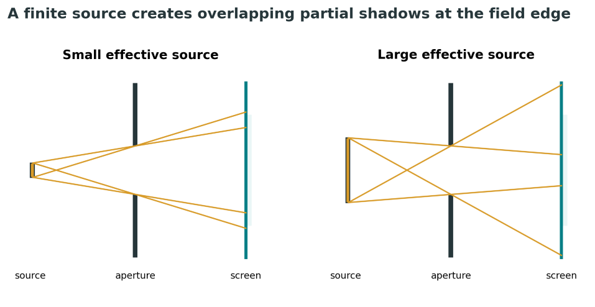
Penumbra Box
A simple visible-light experiment showing how source size and geometry create beam penumbra. Complexity: beginner. Estimated cost: €5–15. Build time: 1–2 hours.
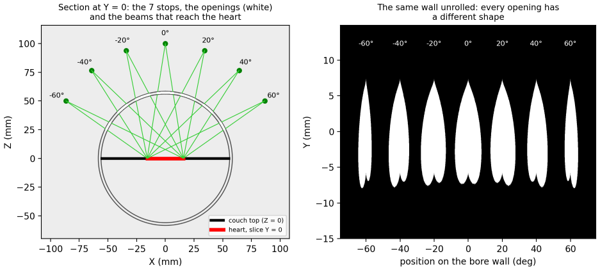
Ethos-Style Collimator Demonstrator
A rotating light-beam model showing why different treatment angles require differently shaped apertures. Complexity: intermediate, with 3D printing. Provisional cost: €20–50. Build time: 4–8 hours, excluding printing.
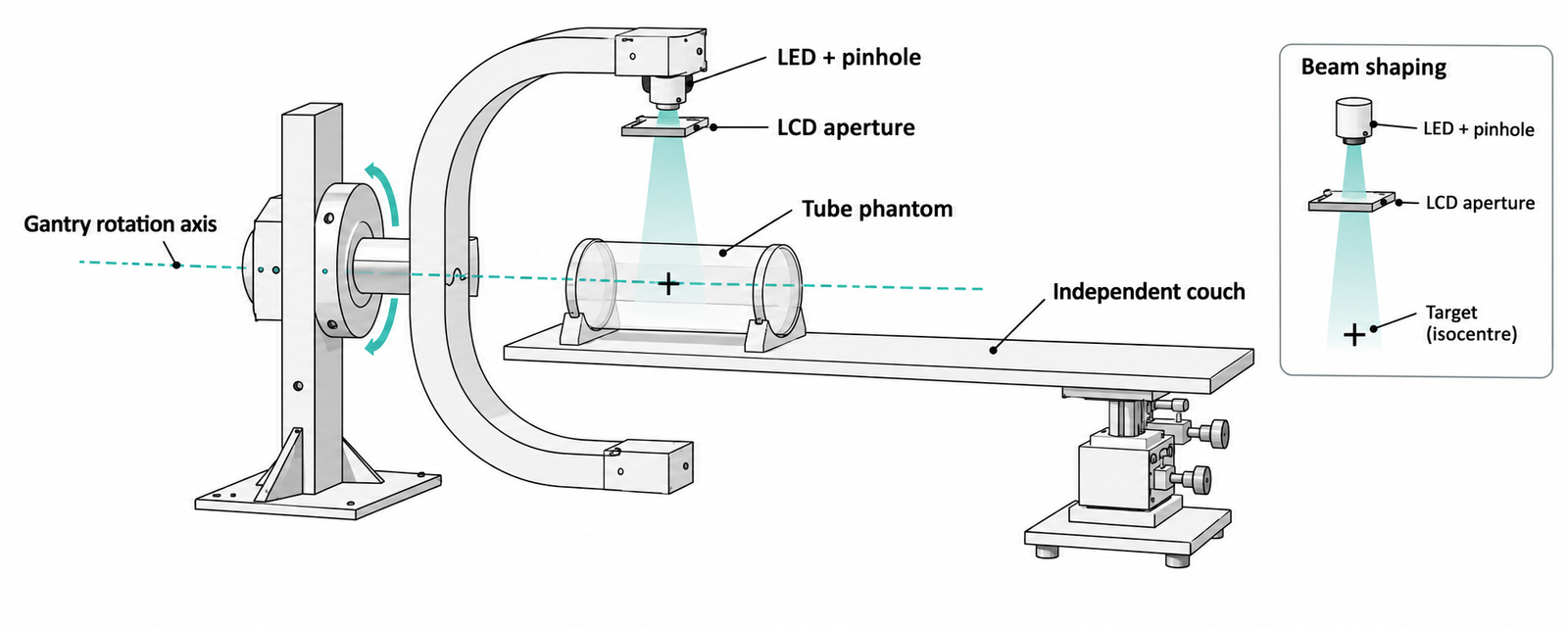
Programmable LINAC Mockup
A working tabletop model demonstrating beam shaping, positioning, motion control and basic quality assurance. Complexity: advanced. Provisional cost: €150–400. Build time: several days.
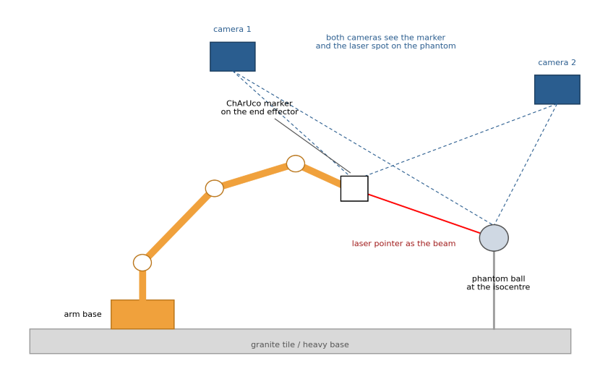
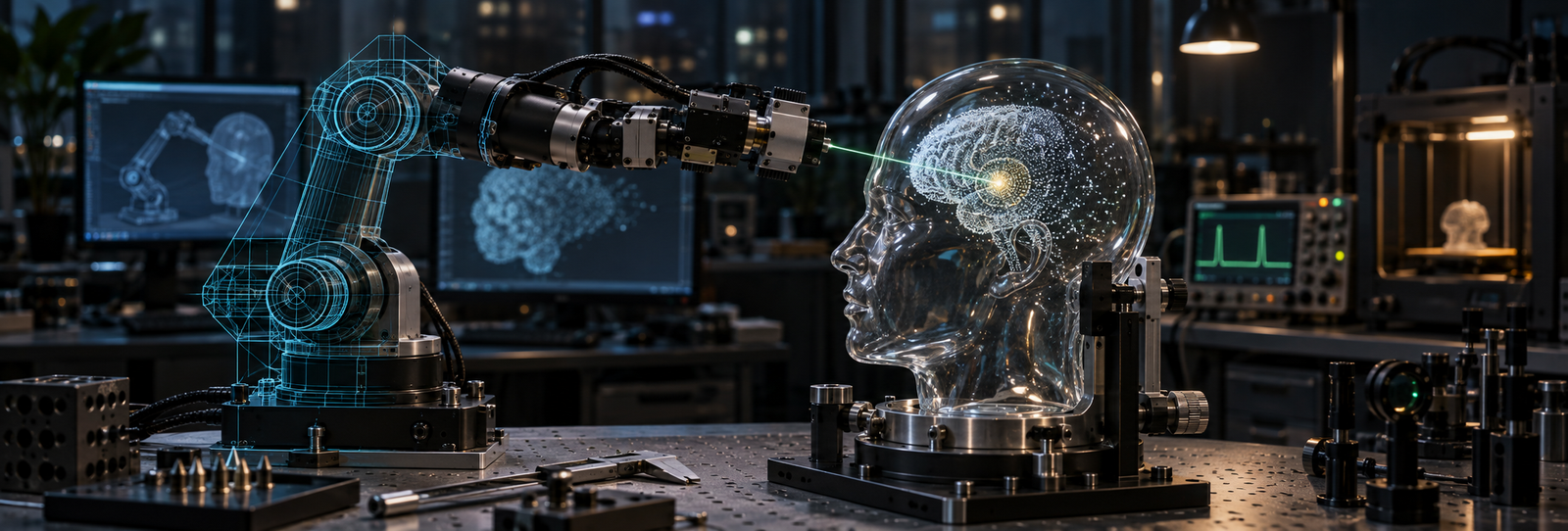
Robotic Arm With Camera Feedback
A camera-guided robotic experiment exploring positioning accuracy, calibration, feedback correction and repeatability. Complexity: advanced. Provisional cost: strongly dependent on the selected robot and cameras. Build time: several days.