AJORA Book 2026
French-language practical oncology handbook for residents, including frequent and urgent situations.
Open original sourcePractical oncology references, supportive care, treatment safety, toxicities and emergencies.
Selected original references and existing clinical tools. Each module keeps its own scientific content and rules.
French-language practical oncology handbook for residents, including frequent and urgent situations.
Open original sourceOriginal French supportive-care guidance: toxicity prevention, symptoms, emergencies and rehabilitation.
Open original sourceNational service-quality reference for access and organization of supportive care.
Open original sourceSeparate guided assessment for prophylaxis, acute review and reassessment.
Open clinical moduleDedicated symptom, disease-context and palliative treatment pathways.
Open clinical moduleConversion workbench with its own units, assumptions and safety checks.
Open clinical moduleOfficial adverse-event terminology and grading reference. The CTCAE documentation tool remains within Clinical Safety.
Open original sourceLong-term treatment effects, symptoms, recovery and shared care.
Open clinical moduleSelect one or more agents to reveal prerequisites, follow-up and overlapping toxicity domains. Only listed, selected agents are covered. Unlisted agents and trial regimens are not assessed; review their protocol separately. No patient data are stored.
Select treatment components to reveal prerequisites, monitoring and combined toxicity signals.
European reference (EMA): test for DPD deficiency before systemic fluorouracil. Known complete deficiency is a contraindication; consider a reduced starting dose for partial deficiency. AJORA 2026, pp.145 and 147.
In France, uracilemia testing before the first prescription has been mandatory since 2019; the prescription workflow must document that the result was considered. Interpret uracilemia cautiously in moderate/severe renal impairment.
European reference (EMA): test for DPD deficiency before capecitabine. Known complete deficiency is a contraindication; consider a reduced starting dose for partial deficiency. AJORA 2026, pp.145 and 147.
French prescribing/dispensing rules require uracilemia before first fluoropyrimidine prescription and documentation that the result was considered.
Assess renal function before treatment; renal impairment changes exposure/dose suitability.
Document serum creatinine/renal function and the regimen-specific creatinine-clearance eligibility threshold. Do not apply one universal cutoff across all protocols.
Ensure protocol-appropriate hydration; magnesium and other electrolytes require active surveillance.
Document the renal-function method used for AUC/formula dosing; impaired renal function increases myelosuppression risk.
Hypersensitivity risk rises with prior platinum exposure and later cycles; emergency medication/equipment must be available.
Use the exact product/regimen protocol: solvent-based paclitaxel and albumin-bound paclitaxel are not interchangeable for premedication or dosing.
Document neuropathy and blood counts before treatment; cumulative neuropathy may require modification.
Surgical timing and wound healing must be checked against the active bevacizumab label/protocol before treatment.
Do not start the monitoring pathway without baseline blood pressure and renal/proteinuria context.
Establish liver enzymes, creatinine and thyroid function before treatment and recognize relevant pre-existing autoimmune/endocrine conditions.
Use reliable venous access and continuous site vigilance. Extravasation can cause delayed extensive necrosis.
Document blood counts and renal function before treatment; toxicity is cumulative.
Rare reactions are exactly why the first response should be rehearsed. This section follows the current ACR adult reaction card and ESUR preparedness principles.
Recognize: Hypotension, tachycardia, respiratory distress, diffuse erythema/urticaria or rapid multisystem reaction after contrast.
ACR Adult Contrast Reaction Card (current page accessed 2026)
Recognize: Inspiratory stridor, progressive throat/facial swelling or airway compromise.
ACR Adult Contrast Reaction Card
Recognize: Expiratory wheeze, dyspnea or reduced air entry after contrast administration.
ACR Adult Contrast Reaction Card
Recognize: Hypotension with bradycardia, pallor, diaphoresis or typical vasovagal symptoms.
ACR Adult Contrast Reaction Card
Recognize: Urticaria, erythema or angioedema without initial cardiorespiratory compromise.
ACR Adult Contrast Reaction Card; ESUR contrast safety guidance
Recognize: Pain, swelling, tightness or visible contrast leakage at the injection site.
ACR Adult Contrast Reaction Card / Manual on Contrast Media
Small canonical morphology examples help residents describe what they actually see before assigning a diagnosis. Images are teaching examples, not diagnostic substitutes.

Morphology example only (miliaria), useful for recognising papules and erythema — not an oncology diagnosis.
CDC / Dr. Lester Cordes · Public domain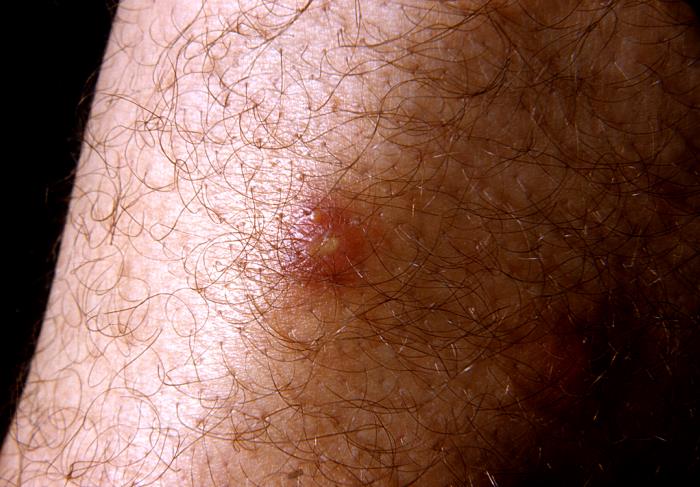
Morphology example only: a discrete pustule with an erythematous halo.
CDC / Dr. Harold G. Scott · Public domain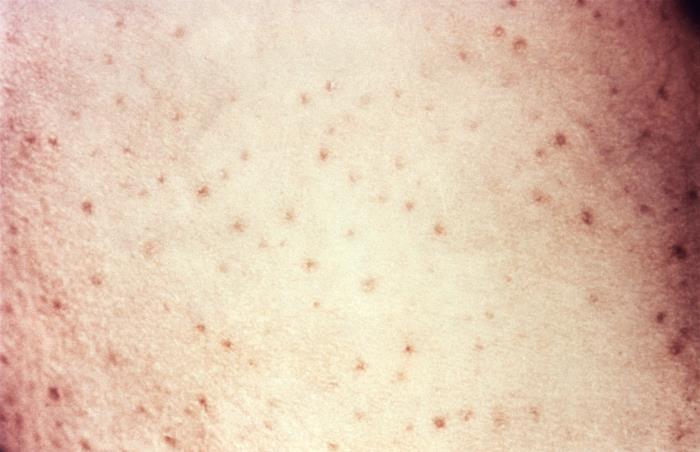
Useful for distinguishing small non-blanching hemorrhagic lesions from inflammatory erythema.
CDC · Public domain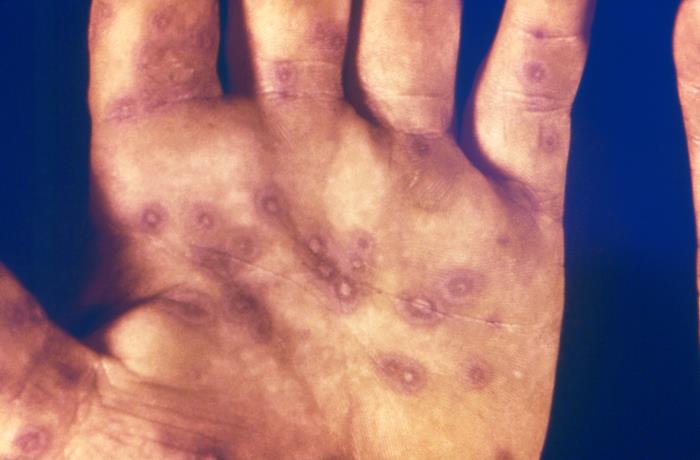
Targetoid morphology can overlap with severe cutaneous adverse-reaction differentials; mucosal involvement or systemic illness raises urgency.
CDC / Dr. N.J. Fiumara · Public domain
Morphology example only (herpes labialis). Use to recognise small fluid-filled vesicles.
CDC / Dr. Hermann · Public domain
High-risk visual red flag. Painful rash, mucosal or ocular involvement, epidermal detachment or systemic illness warrants urgent specialist/emergency assessment.
James Heilman, MD · CC BY-SA 3.0Painful rapidly progressive rash, mucosal or ocular involvement, epidermal detachment, targetoid lesions with systemic illness, or extensive blistering/desquamation should trigger immediate treatment hold where clinically appropriate and urgent specialist/emergency assessment. Do not wait for a perfect dermatologic label before escalating.
Use the exact CTCAE term and grade definition. The documentation helper does not infer a grade automatically in this preview.
ONS/ASCO supports agent-specific antidotes and early specialty/surgical escalation for high-risk injury. For mitomycin, DMSO is an agent-specific option in the current ONS/ASCO algorithm; local extravasation kits and protocols should be immediately available.
Safety information is versioned clinical content. The engine separates prerequisites, monitoring, toxicity overlap, emergency action, CTCAE terminology and jurisdiction overlays. Regimen-specific thresholds stay attached to validated regimen/source packages rather than being generalized across oncology.
Overlap detection is intentionally conservative: it surfaces shared toxicity domains but does not calculate a patient-specific risk score. Visual examples are morphology teaching aids; the clinician still determines diagnosis and CTCAE grading from the actual clinical context.